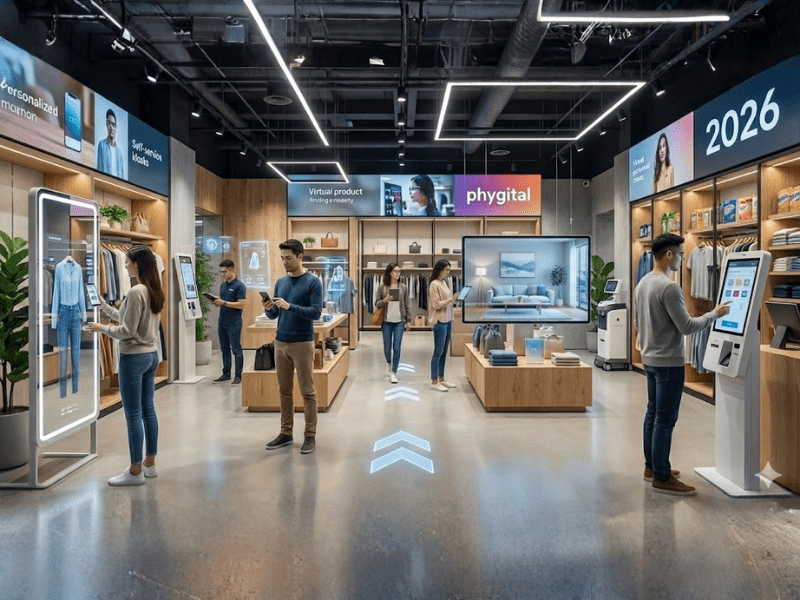
In the rapidly changing retail landscape, Phygital retail 2026 stands out as a key trend transforming the industry. Phygital retail is evolving through practical self-service and AR use cases. Here’s where U.S. retailers are seeing real operational value.
Phygital Retail: Beyond the Buzzword
The term phygital retail is often used loosely to describe any blend of digital tools inside physical stores. In practice, however, phygital retail is far more specific and far more constrained than many trend pieces suggest.
In 2026, phygital retail does not mean fully automated stores, invisible checkout everywhere, or immersive AR experiences across every aisle. What it does mean is something more practical and more impactful: selective digital layers that reduce friction, improve decision-making, and support store operations without disrupting them.
The convergence of self-service technologies and augmented reality (AR) is beginning to show value, but only when deployed with discipline and realistic expectations.
Why Retailers Are Moving Toward Phygital Models
U.S. retailers are moving toward phygital models for the same reason they adopt any technology: operational pressure. Labor remains tight, store execution is more complex than it was five years ago, and customer expectations for speed and clarity continue to rise. In that environment, a purely “human-driven” operating model becomes difficult to scale without sacrificing either service quality or profitability.
Phygital initiatives are being tested because they can absorb repetitive interactions that quietly consume time and labor, such as locating products, comparing options, verifying details, and completing transactions efficiently. Self-service reduces friction at the point of purchase. AR reduces friction at the point of decision. When retailers combine both in the right places, they’re not chasing novelty; they’re protecting store performance and making the in-store journey more straightforward to navigate for both customers and associates.
Self-Service in 2026: Mature, But Not Universal
Self-service is mature in 2026, but maturity doesn’t mean universality. Retailers understand where self-checkout and kiosks perform well and where they create friction, especially when exception handling becomes the dominant workload. The best deployments treat self-service as a performance channel that must be engineered: integrated with pricing logic, supported by clean item data, and designed to minimize breakdown points that trigger associate intervention.
This is why the conversation in 2026 is less about “adding more self-service” and more about making self-service reliable at scale, reducing the operational burden of exceptions while preserving throughput and customer confidence.
Where Augmented Reality Actually Makes Sense in Stores
AR adoption in retail has been uneven because many early use cases prioritized novelty over utility. That is changing.
The most defensible AR deployments in 2026 focus on information clarity, not immersion:
- product visualization (size, color, fit, finish)
- ingredient and attribute transparency
- spatial guidance in large-format stores
- assisted comparison for complex categories
Beauty and specialty retail remain the clearest examples of AR delivering measurable value. Sephora’s Virtual Artist allows customers to test products digitally before purchase, reducing uncertainty and increasing confidence.
In home improvement, Lowe’s has publicly discussed using AR and spatial tools to help customers and associates navigate complex assortments and layouts.
These examples matter because they reflect bounded, realistic use cases rather than speculative futures.
The Real Opportunity: Where Self-Service and AR Intersect
The strongest phygital results appear when AR and self-service are not treated as separate initiatives.
Consider a realistic 2026 flow:
A customer uses AR on their phone or a kiosk to compare products or understand specifications. Once the decision is made, self-service tools allow them to complete the transaction quickly, without re-entering information or waiting for assistance.
This intersection delivers value by:
- Shortening decision cycles
- Reducing repetitive associate questions
- lowering checkout friction
- improving throughput during peak hours
The store does not become automated.
It becomes more legible and more efficient.
Why Phygital Retail Has Limits And Why That’s Healthy
Phygital retail has clear limits, and acknowledging them is a sign of operational maturity, not pessimism. The most significant constraint is that these experiences depend on fundamentals that many retailers are still strengthening: clean product data, reliable connectivity, consistent pricing logic, and systems that can integrate without creating new complexity for stores. If those foundations aren’t stable, even well-designed AR or self-service experiences can degrade quickly, showing incorrect information, creating checkout exceptions, or forcing associates to spend time “fixing” what was meant to streamline.
There are also category realities. AR and digital overlays deliver the most value in products where uncertainty is high, such as fit, finish, shade, configuration, ingredients, or compatibility. In categories where decisions are routine or low in involvement, AR often becomes unnecessary. And from an operational lens, retailers remain cautious about anything that increases shrink exposure or exception management workload. That’s why the most credible phygital strategies in 2026 aren’t about doing everything everywhere. They’re about selecting the few touchpoints where digital layers measurably reduce friction, then scaling them with discipline.
The Role of AI: Orchestration, Not Automation Everywhere
AI’s role in phygital retail is often misunderstood. In 2026, AI is less about automating every interaction and more about orchestrating systems behind the scenes.
This includes:
- synchronizing inventory visibility
- aligning pricing across touchpoints
- personalizing recommendations responsibly
- detecting anomalies and exceptions
- supporting decision-making for store teams
Major cloud providers document how AI supports retail personalization, forecasting, and operational efficiency when data foundations are unified.
AI does not replace the store.
It reduces noise inside it.
What Retail Leaders Should Focus on in 2026
For executives evaluating phygital investments, three priorities consistently separate effective deployments from failed pilots.
First, focus on a single high-impact use case, whether that is AR-assisted product comparison, self-service checkout optimization, or in-store navigation, scale one capability thoroughly before adding others.
Second, invest in data and content governance. AR and self-service rely on accurate product data, pricing, and inventory. Without clean inputs, the experience degrades quickly.
Third, design workflows that support associates, not compete with them. Technology should absorb repetitive tasks while empowering staff to handle exceptions and complex interactions.
Phygital retail works best when it strengthens fundamentals rather than reinventing the store.
A Realistic Outlook for 2026
Phygital retail in 2026 is not a revolution; it’s a disciplined evolution. The retailers that win will not be the ones with the most ambitious demos, but the ones that apply self-service and AR in ways that clearly reduce friction, protect margins, and support store teams without adding complexity.
The direction is clear: stores are becoming more “digitally legible” rather than fully automated. Customers are being given more autonomy, not left to fend for themselves. Associates are being elevated to exception handlers and experience enablers, not replaced. That is the realistic version of phygital retail, and it’s precisely why it can scale.
In 2026, phygital retail will not reward ambition. It will reward operational discipline.
That realism is precisely what makes phygital retail viable.

Connect with me on LinkedIn, follow me on X (https://x.com/adriana_rivas_b), and stay up-to-date on the latest in retail technology and innovation at adrianarivas.tech.
Leave a Reply